
Personal auto policies are built around a very specific assumption: that you're driving for personal reasons. The second a vehicle becomes a tool of your trade, insurers see it differently. And that difference between what your personal policy covers and what actually happens on a workday can translate into denied claims, out-of-pocket repair bills, and liability costs that might damage your business.
This isn't a technicality buried in the fine print - it's a distinction that insurance companies take seriously, and one that leaves an interesting number of small business owners exposed without realizing it. A fender bender on the way to a job site or an accident while hauling equipment can quickly become a financial problem that a personal policy simply wasn't designed to manage.
I'll talk about how to figure out if your work truck needs commercial auto insurance, what situations put you most at risk under a personal policy, and what to look for when evaluating your coverage options.
Key Takeaways
- Personal auto policies exclude business use, meaning claims from job-site accidents or hauling equipment can be denied entirely.
- Trucks over 10,001 pounds GVWR used for business require USDOT registration and federal minimum liability coverage up to $5,000,000.
- Most construction contracts require at least $1,000,000 combined single limit liability coverage; falling short may cost you work.
- Standard commercial auto policies don't cover tools and equipment inside the truck - a separate inland marine policy is needed.
- Monthly premiums range from $250-$400 for light-duty contractors to $900-$1,800 for owner-operators running under their own authority.
When a Personal Auto Policy Won't Cover Your Work Truck
Personal and commercial auto policies are built around different assumptions about how a vehicle gets used. A personal policy assumes you're driving to the grocery store, taking road trips, or commuting. A commercial policy assumes the vehicle is part of how you make money. That changes the risk calculation considerably.
Insurers treat business use as a separate category because the exposure is different. A truck that hauls materials to job sites every day faces more wear, more road time, and more liability than one that sits in a driveway most of the week; it's why personal policies usually have business-use exclusions in the fine print.
These exclusions tend to be wider than expected. Using your truck to transport tools, carry equipment, make deliveries, or drive between job sites can all count as business use in the eyes of your insurer. You don't need to be hauling a full load or running a fleet for the exclusion to apply.
A denied claim looks like this in practice. You get into an accident on the way to a job site with your truck bed full of supplies. You file a claim with your personal auto insurer and they ask about the circumstances. Once they determine the truck was in use for business purposes, they can deny the claim - and you're left to cover vehicle damage, medical bills, and any liability out of pocket.
That's not a worst-case scenario; it's a documented reason why business-use exclusions exist in personal policies. Insurers aren't penalizing you for working - they're pricing policies based on how a vehicle is actually used, and personal coverage isn't priced for commercial exposure.
Some personal policies do have an optional business-use endorsement. But these are limited. They might cover light incidental use but won't extend to hauling, deliveries, or standard job-site travel - it's worth reading your policy declarations page so you don't have to find out the hard way what's covered.
The line between personal and business use isn't always obvious, and that gray area is where claim denials happen. Knowing where your personal policy ends is the first step to figuring out what coverage your work truck actually needs.
Which Trucks Are Legally Required to Carry Commercial Coverage
The legal requirements for commercial truck insurance go beyond personal policy limitations. Federal law draws a hard line at 10,001 pounds gross vehicle weight rating (GVWR). If your truck hits that threshold and you use it for business purposes, you are required to register with the FMCSA and carry a USDOT number.
That number comes with insurance requirements attached to it. The Federal Motor Carrier Safety Administration sets minimum liability limits based on what you haul and how heavy your vehicle is. For general freight, the federal floor is $750,000 combined single limit. If you transport hazardous materials, that number can climb to $5,000,000.
State laws add another layer on top of federal minimums. New Jersey, just to give you an example, raised its state minimum to $1.5 million as of July 1, 2024; it's well above the federal baseline and it shows how much coverage requirements can vary depending on where you work. Our Coverage Corner breaks down how these rules differ across states and industries.
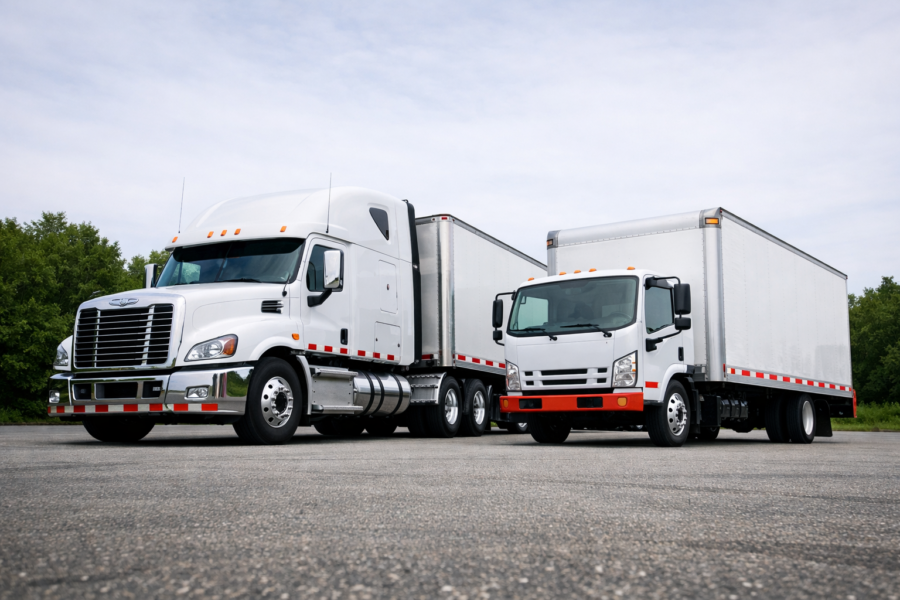
Most light-duty pickups fall under that 10,001-pound GVWR threshold, so they don't trigger a USDOT filing requirement on their own. Once you step up to a medium-duty box truck or anything heavier, the federal laws apply once you put the truck to work for a business. If you're unsure where your operation falls, our General Liability and commercial coverage specialists can help you sort through the requirements. The table below breaks down how vehicle weight connects to registration and liability minimums.
| Vehicle Type | Typical GVWR | USDOT Required? | Minimum Liability (Federal) |
|---|---|---|---|
| Light-duty pickup (contractor) | Under 10,001 lbs | No | Varies by state |
| Medium-duty box truck | 10,001-26,000 lbs | Yes (business use) | $750,000 CSL (general freight) |
| Heavy-duty semi/tractor-trailer | Over 26,001 lbs | Yes | $750,000-$5,000,000 CSL |
Even if your truck doesn't hit that federal threshold, your state may still have its own laws about commercial vehicle coverage. The GVWR cutoff is a starting point. But it's not the whole picture for every operator. Contact us to make sure your policy lines up with what your state actually requires.
What Coverage Limits Contractors and Tradespeople Actually Need
Once your truck needs commercial coverage, the next question is how much. For most contractors and tradespeople, the answer means satisfying your insurer and the clients who hire you.
Most commercial construction contracts set a minimum of $1,000,000 combined single limit, or CSL; it's a single liability number that covers bodily injury and property damage together. If you show up to bid a job with less than that, you might not get the work at all.
Combined single limit coverage is worth understanding. A split-limit policy might show something like 100/300/100, which means $100,000 per person, $300,000 per accident, and $100,000 for property damage. A $1,000,000 CSL policy collapses that into one number, which goes further when an accident involves multiple injuries or property damage.
The reason that ceiling exists is that accidents involving work trucks can be expensive in a hurry. The National Safety Council reported that over 117,000 large trucks were involved in crashes in 2021, with more than 5,700 of them being fatal. Even a non-fatal accident with injuries, a totaled vehicle, and legal fees can climb well past a $100,000 per-person limit.
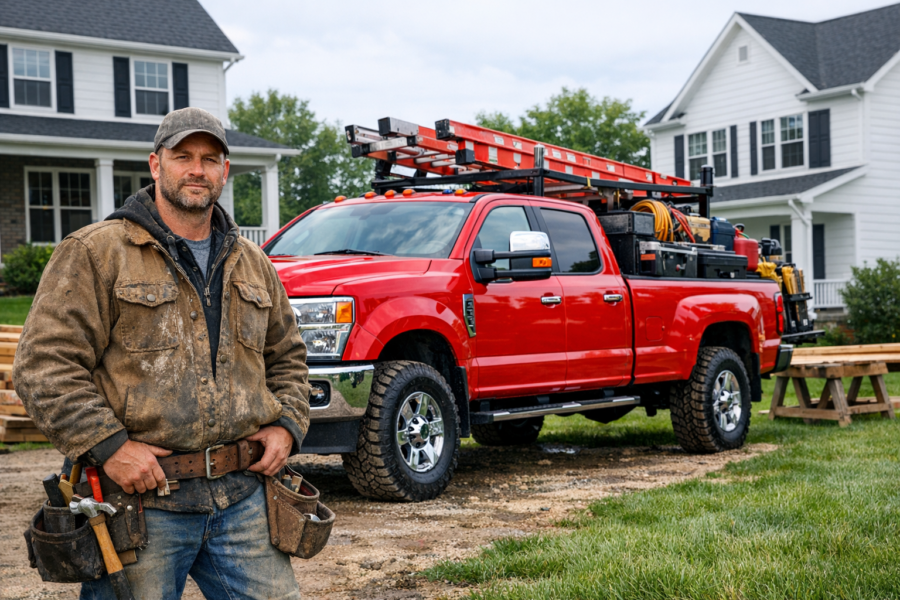
For lighter trades - plumbers, electricians, landscapers - your truck probably isn't a semi. But your liability exposure is still real. You're driving a loaded vehicle through residential neighborhoods, parking near job sites, and making multiple stops a day; it adds up on the road.
Beyond liability, tradespeople should also think about the tools and equipment in the truck. Standard commercial auto policies don't cover that. A separate inland marine or tools and equipment policy is needed to protect the gear itself. You may also want to review workers compensation coverage if you have employees working out of that truck.
Here is an easy overview of what most contractors in the trades actually carry:
| Coverage Type | Recommended Minimum | Why It Matters |
|---|---|---|
| Liability (CSL) | $1,000,000 | Meets most contract requirements |
| Uninsured Motorist | $100,000+ | Protects you if the other driver has no coverage |
| Comprehensive & Collision | Actual cash value of truck | Covers damage to your own vehicle |
| Tools & Equipment | Based on inventory value | Separate from auto; covers gear in the truck |
If a covered accident happens and your limits fall short, the difference comes out of your pocket personally; it's the part worth taking seriously when you set your coverage limits. Explore our full range of insurance services to make sure every part of your business is protected.
How Much Commercial Auto Insurance Costs for Work Trucks in 2026
Now that you know what coverage to get, the cost depends quite a bit on what operator you are.
| Operator Type | Estimated Monthly Cost (2026) |
|---|---|
| Light-duty contractor (plumber, electrician, etc.) | $250-$400 |
| Owner-operator (own authority) | $900-$1,800 |
| Leased operator (under carrier authority) | $250-$500 |
Light-duty contractors - plumbers, electricians, HVAC techs - usually land in the $250 to $400 per month range. Owner-operators running under their own authority pay considerably more, anywhere from $900 to $1,800 per month, because they carry the full weight of liability on their own. Leased operators under a carrier's authority get a bit of a break, usually paying $250 to $500 per month.
Premiums across the board have been climbing. A 2023 Milliman study found that commercial auto liability insurers posted an average loss ratio of 81% - which means insurers paid out $0.81 in claims for every dollar they took in premiums; it's a tight margin - and it has pushed carriers to raise rates to stay solvent.
Several things can move your premium up or down from these ranges. Your driving record is one of the biggest - at-fault accidents and traffic violations will raise your rate noticeably. The type of cargo you haul matters too. Hazardous materials or high-value goods carry more exposure than standard tools and equipment.
Your radius of operation factors in as well. Trucks that stay local tend to get better rates than the ones running long interstate routes. Vehicle age is another factor - newer trucks with modern safety features can sometimes qualify for lower rates. But older vehicles may cost more to insure because parts and repairs are pricier.
The best way to get an accurate number is to collect quotes from multiple carriers and be upfront about your use. Misrepresenting how you use your truck - even accidentally - can get a claim denied down the road, which would cost far more than any premium savings.
Getting the Right Coverage Before You Need It
Take an hour this week to pull out your latest auto policy and actually read how it defines business use. Then think about how you use your truck - the weight it carries, the clients depending on it, and if any of your contracts require coverage limits. If anything feels vague or you're second-guessing yourself, that's your cue to call a licensed commercial insurance agent. Not a general quote website - not a friend who "knows about insurance" - an agent who works with commercial vehicles and understands the dangers of your trade. See what our clients have to say about working with our team.
The right coverage keeps a bad day from becoming a business-ending one. Download our free guide to learn more about protecting your business.
FAQs
Does my personal auto policy cover my work truck?
Almost certainly not. Personal auto policies include business-use exclusions, meaning claims from job-site travel, hauling equipment, or transporting tools can be denied entirely, leaving you responsible for repair bills and liability costs out of pocket.
When is commercial auto insurance legally required for trucks?
Federal law requires USDOT registration and commercial coverage for trucks exceeding 10,001 pounds GVWR used for business. Minimum federal liability limits range from $750,000 to $5,000,000 depending on cargo type and vehicle weight.
How much liability coverage do contractors typically need?
Most commercial construction contracts require at least $1,000,000 combined single limit (CSL) liability coverage. Carrying less may disqualify you from bidding on jobs entirely.
Does commercial auto insurance cover tools inside my truck?
No. Standard commercial auto policies do not cover tools and equipment stored in your truck. A separate inland marine or tools and equipment policy is required to protect your gear.
How much does commercial auto insurance cost in 2026?
Light-duty contractors typically pay $250-$400 per month. Owner-operators running under their own authority pay $900-$1,800 monthly. Driving record, cargo type, and operating radius all influence your final premium.
With over 25 years of combined experience in the Insurance Industry and excellent custom service, we are your trusted local brokers specializing in all types of insurance solutions.